Barcelona Apartment Partial Renovation: The Real 2026 Budget Breakdown You Need
Discover the real 2026 partial renovation budget for a Barcelona apartment. Get honest costs, hidden fees, and smart saving tips.
Thinking about renovating your Barcelona apartment but dreading the financial unknown? You’re not alone—and full gut jobs aren’t the only path. In 2026, a smart, targeted partial renovation can transform your space without the six-figure sticker shock, but only if you know exactly where your euros are going. This guide breaks down the real, city-specific costs for updating a kitchen, bathroom, or flooring in a typical Catalan flat, including hidden fees like community permits and waste disposal. By the end, you’ll have a realistic 2026 budget range and the insider knowledge to avoid overpaying contractors in this competitive market.
Understanding What Counts as a Partial Renovation in Barcelona
In Barcelona’s 2026 construction landscape, a partial renovation is a deliberately bounded intervention. It typically targets one or two key functional areas—a bathroom, kitchen, or the flooring of a single dwelling—without touching the building’s structural bones. You are not moving load-bearing walls, underpinning foundations, or altering the facade’s original openings. The legal threshold governing whether you can proceed under a lighter administrative regime is tied to the valor cadastral of the entire building. If your works cost less than 30% of that total assessed value, you avoid the full obra major permit process, which in Barcelona can take months and requires a complete project by an architect. Instead, you operate under comunicació prèvia—a prior notification to the Ajuntament that your scope is partial.
Be precise, though. Even under this lighter regime, any change to the internal distribution of rooms—say, moving a partition between a kitchen and a living area—still triggers a mandatory comunicació prèvia with a simplified technical report. The filing fee in 2026 runs from €85 to €210 per submission, depending on the surface area affected. Crucially, the 30% rule is not about your budget; it is about the building’s cadastral value. A €40,000 kitchen remodel in a building worth €1.2 million easily stays under the threshold, while a €15,000 job in a tiny, low-value building might not.
When You Need a Technical Architect or Engineer
Do not assume that a partial renovation lets you skip professional oversight. If your scope touches a load-bearing wall, any part of the shared facade, the building’s communal entrance, or the roof structure—even for a single pipe run—you must engage a registered aparellador (technical architect) or a qualified engineer. This is not a bureaucratic nicety; it is a legal requirement under the 2026 municipal fee schedule. The professional’s signature is what makes your comunicació prèvia valid.
The aparellador’s duties go beyond drawing a plan. They inspect the existing conditions, certify that your partial works do not compromise structural safety, and prepare the mandatory memòria tècnica for the City Council. For a typical partial renovation in Barcelona, their fee ranges from €1,200 to €3,500, depending on the complexity of the existing construction (e.g., Catalan vaults require more analysis) and the number of site visits. Skip this step, and the Ajuntament can issue a stop-work order and impose fines starting at €3,000—far exceeding the professional’s cost.
Also note that in 2026, the City Council has tightened enforcement on shared elements. Even replacing a bathroom exhaust fan that vents into a communal shaft now requires the aparellador’s sign-off. Budget for that professional from day one.
The Real Cost Drivers in 2026: Beyond Square Meters
Anyone quoting a flat per-square-meter rate for a Barcelona partial renovation is selling you a fantasy. By mid-2026, the gap between a budget refresh and a high-end overhaul has become a chasm, driven by three forces that have little to do with floor area.
Your postal code is the first silent budget killer. In the Gothic Quarter or El Born, medieval streets and pre-20th-century buildings push logistics costs up 15–20%. Delivery trucks often can’t reach the door, so materials move by hand-trolley through pedestrian-only lanes, and crane permits are either impossible or prohibitively expensive. In the Eixample’s wider blocks or newer districts like 22@, standard loading zones and freight elevators slash handling time. Building age matters just as much: a 19th-century finca without a lift forces workers to haul tiles, plaster, and a mini-batch concrete mixer up several flights, costing an extra €25 to €45 per worker per hour. If your building does have a freight lift, expect a common-area usage fee—often €50 to €150 per day—plus mandatory insurance for its operation during your works.
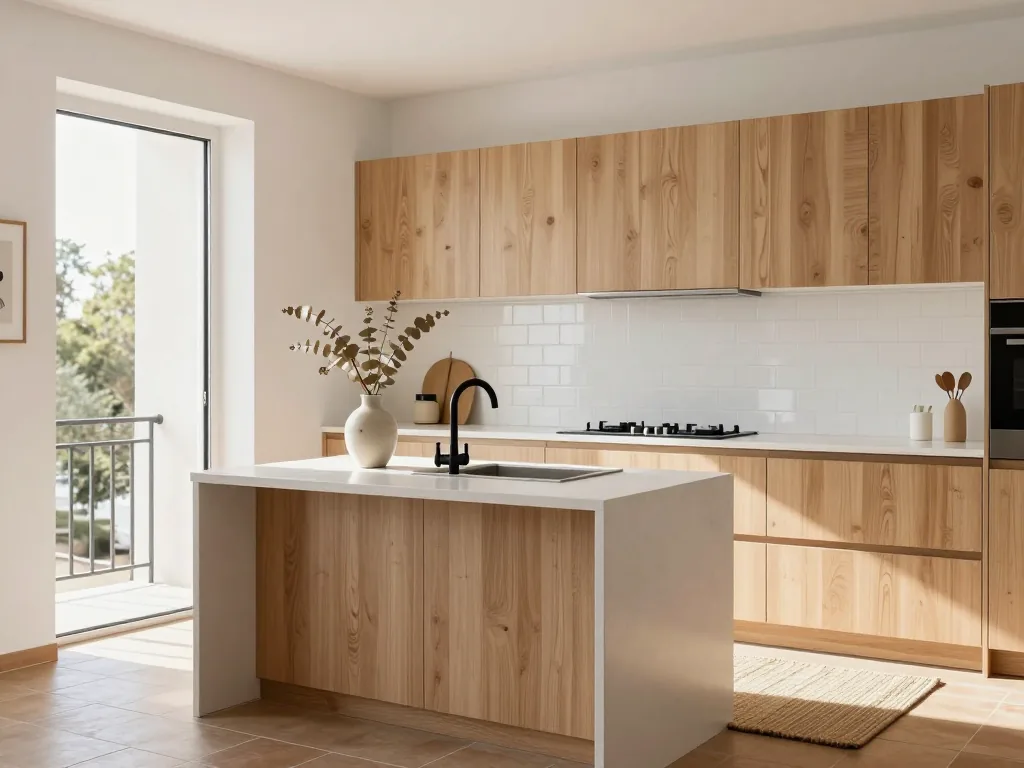
Finish levels can triple your per-square-meter spend. Standard ceramic tile runs €30 to €60 per square meter installed in 2026; mid-range porcelain or natural stone jumps to €80–€140. Premium options—large-format marble, custom terrazzo, imported oak parquet—easily hit €180–€300, labor included. Global supply chains have stabilized since the 2022–2023 spikes, cutting some raw material costs 8–12%, but labor is the real inflation driver. Skilled tilers and plasterers remain scarce in Catalonia, with day rates at €180–€260 and bookings weeks out. That scarcity negates material savings. A mid-range kitchen and bath partial renovation in a standard apartment now runs €700 to €1,100 per square meter; premium work starts at €1,400.
Two regulatory costs catch nearly every owner off guard. The Catalan Waste Law (Decret 210/2018) is strictly enforced in Barcelona: at least 70% of construction debris must be recycled, and you’ll need a certified gestor de residus. Budget €300–€600 for a small partial renovation’s waste skip, transport, and certification—more if you’re demolishing tile-backer boards or plaster walls. Separately, Barcelona’s 2026 Pla de Millora Energètica triggers basic insulation requirements if your work touches more than 25% of the building envelope—for example, replacing exterior windows or adding a new interior partition against a facade. A minimal upgrade—cavity wall injection or 4 cm of interior thermal board on one wall—adds €1,200–€2,800, but it’s non-negotiable for permit approval. Factor these in before signing any contractor quote.
Before a single wall comes down, you need your paperwork in order. In Barcelona, skipping the administrative phase for even a partial renovation can lead to fines, a work stoppage order, and serious complications when you later try to sell. Two non-negotiables must be handled in 2026.
The Comunicació Prèvia and Taxa per Llicències Urbanístiques
Any structural or layout change—even removing a non-load-bearing wall between the kitchen and living room—requires filing a Comunicació Prèvia with the Barcelona City Council. This isn’t a full obra major license, but it’s a mandatory declaration formally notifying the council of your intent to alter the property’s configuration. Work cannot legally begin until it’s submitted and acknowledged. The associated fee, the Taxa per Llicències Urbanístiques, is calculated under the 2026 Ordenança Fiscal. It’s not flat; rather, it’s a percentage of your declared renovation budget multiplied by your floor area. For a typical 70 m² partial renovation, expect municipal fees between €350 and €1,200, depending on scope and declared cost. A serious caution: under-declaring your budget to reduce this fee is common but illegal. The council cross-references declared values with market averages. If your figures seem unrealistically low, you’ll face an audit, surcharges, and fines that dwarf any savings.
Verifying the Building’s ITE Status
Since 2021, Barcelona has strictly enforced the Inspecció Tècnica d’Edificis (ITE) for all buildings over 45 years old. This structural and safety inspection of the entire property is non-negotiable in 2026. If your renovation touches any shared element—reinforcing a party wall, opening a new window onto a communal courtyard, or repairing a roof section above your unit—you must verify the building’s ITE certificate is current and valid. An expired ITE or one with pending deficiencies will cause the City Council to block your Comunicació Prèvia until a new inspection passes. That delay can stretch three to six months and cost €800 to €2,500 for the inspection plus any mandatory corrective works. Always request a copy of the current ITE certificate from the building’s administrator before hiring a contractor; it’s the single most common reason partial renovations stall in Barcelona.
Contractual Requirements and Consumer Protections
Before any work begins on your Barcelona apartment, the paperwork matters as much as the plasterwork. Spain’s renovation sector is tightly regulated, and understanding your contractual rights can prevent costly disputes and substandard work. Your contract is more than a formality—it is your primary legal shield.
Mandatory Budget, VAT, and Warranty Terms
Every renovation contract in Spain must include a detailed, itemized budget breaking down labor, materials, and management fees. The 21% IVA (VAT) must appear separately and clearly, never buried in a lump sum. If a contractor offers a single “all-in” price without this breakdown, walk away. The law demands transparency, and itemization is the only way to verify you aren’t charged for phantom materials or inflated hours.
Consumer protection is reinforced by the Ley de Ordenación de la Edificación (LOE), which mandates minimum warranty periods your contract must explicitly reflect. For partial renovations, you’re guaranteed at least one year of coverage for defects in materials or finishes—cracking tiles, peeling paint—and three years for defects in installation or structural elements, such as faulty plumbing behind a new wall or electrical failures. Your contract cannot waive these rights; any clause attempting to reduce them is legally void. The warranty start date should be clearly defined, typically the day the final certificate of completion is signed, not when work begins.
The Libro de Órdenes (Site Diary)
If your partial renovation lasts beyond six months or involves more than one contractor—say, a separate electrician and carpenter—you’re legally required to maintain a Libro de Órdenes, or site diary. This isn’t optional bureaucracy; it’s a protective logbook recording daily activities, incidents, safety checks, and any instructions given or received. The lead contractor must keep it on-site and accessible.
In practice, this diary is invaluable during a dispute. A damaged neighboring wall or late delivery gets logged. A mid-project change request is recorded with a date and signature. If a warranty claim arises later, the diary provides a chronological, legally admissible record of what was done, when, and by whom. For a typical partial renovation in Barcelona—updating a kitchen and bathroom, for instance—you might not reach the six-month threshold. But redoing floors throughout a large finca apartment likely will. Insist on this diary from day one; a reputable contractor will welcome it, while a disorganized one will resist. The cost of maintaining it is negligible, yet the protection against costly litigation is invaluable.
Getting Accurate Quotes: The Three-Bid Rule
In Barcelona’s 2026 renovation market, the gap between a smooth partial renovation and a financial headache often comes down to how you collect and compare quotes. The golden rule: obtain at least three itemized estimates from registered contractors. Verify their legitimacy through official registries—RAIC for project managers, or CAATEEB for technical architects and aparelladors. Don’t rely on a friend’s recommendation or a social media post. The registry check is non-negotiable in 2026, as unregistered “professionals” still operate informally, especially in Ciutat Vella and Eixample.
How to Compare Itemized Estimates
When the three quotes arrive, resist comparing bottom-line totals. Instead, build a simple spreadsheet and go line by line. Every serious quote must break costs into four categories: materials (with brand names and models), labor (hours or per-square-meter rates), waste removal (including the mandatory contenedor rental and the eco-tax for construction debris, which runs €120 to €180 per ton in 2026), and a contingency allowance. In Barcelona, a realistic contingency is 10% to 15% of the subtotal—not a flat €500. Also, check that the quote explicitly includes energy efficiency measures if you’re touching walls or windows. Under the 2026 Catalan building code, any partial renovation altering the building envelope must include basic insulation upgrades, typically adding €25 to €45 per square meter. If a quote lumps everything into one vague “renovation package,” ask for a detailed breakdown before proceeding—or request a personalized quote from a firm that provides transparent line items from the start.
Red Flags in Quotes and Contracts
Three warning signs should make you walk away immediately. First, a quote that omits waste management costs. In 2026, Barcelona’s municipal waste ordinance is strictly enforced; fines for illegal dumping start at €750. Second, any estimate that fails to list VAT (21% in Spain) separately—this usually signals a “cash discount” that leaves you without a legal invoice. Third, a contract demanding more than 30% upfront or lacking a payment schedule tied to verifiable milestones (e.g., 30% on signing, 30% after demolition and rough-in, 30% before final finishes, 10% on completion). A reputable contractor will never ask for 50% or more before work begins, and in 2026, most registered firms accept milestone payments via bank transfer with digital receipts. If a quote feels too clean or too cheap, it’s usually hiding a structural problem—get a second opinion from an independent aparellador before signing anything.
Budgeting for Contingencies and Unexpected Finds
The 10-15% Contingency Rule
Barcelona’s older building stock—particularly the finestres and escales built between 1900 and 1960—has a way of revealing its true condition the moment a contractor opens a wall. You might plan a simple kitchen refresh and find internally corroded galvanised steel pipes, or discover that the electrical wiring is still cloth-insulated: a genuine fire hazard. Asbestos is another frequent, unwelcome guest. Widely used in Spanish construction as insulation and in cement pipes until the early 1990s, its safe removal requires a certified specialist. Since you cannot inspect inside a wall without opening it, the industry standard is to set aside a non-negotiable contingency of 10% to 15% of your total renovation budget. On a typical partial renovation of €30,000 to €60,000, that means having an additional €3,000 to €9,000 in liquid reserves, untouched, before you begin. Treat this not as an optional buffer but as a line item as fixed as tiles or labour. In 2026, material costs and tradesman rates in Barcelona have stabilised yet remain high, so the contingency is not for upgrades—it is strictly for survival when the unexpected appears.
Handling Structural Surprises Legally
If your contractor uncovers a sagging beam, a cracked load-bearing wall, or water damage that has rotted the wooden joists—a common issue in entresuelos and ground floors with poor ventilation—stop all work immediately. Do not let anyone “patch it quickly.” Under Catalan building regulations, you are legally obliged to halt and notify your tècnic, either an architect or an aparellador (technical architect). They will assess whether the issue is structural or merely superficial. Here is the critical cost trap: if the repair involves altering the structure, your existing comunicació prèvia—the light-touch declaration covering most partial renovations—may become invalid. Structural interventions typically require a full obra major permit, which involves a more detailed project, a different fee from the college of architects, and a longer municipal review process. Budget for this possibility. A permit amendment or new licence can cost anywhere from €800 to €2,500 depending on scope and the architect’s fees, plus municipal taxes of roughly €150 to €400. On top of that, structural reinforcement work itself—such as steel beam insertion or pillar jacketing—will add €4,000 to €12,000 per intervention. The legal route is non-negotiable; proceeding without the updated permit risks a municipal stop-work order, fines up to €30,000, and forced demolition of non-compliant work. Always have your technical architect’s direct line on speed dial.
Waste Management and Sustainability Compliance
Recycling and Disposal Requirements
Barcelona’s municipal rules tighten further in 2026, and your contractor must submit a formal waste management plan before any permits are pulled. This isn’t a bureaucratic afterthought—it’s a budget line that can shift by a meaningful margin. The plan has to show that at least 70% of your construction debris is diverted from landfill and routed to certified recycling facilities. For a partial renovation—say, gutting one bathroom and updating a kitchen—you’ll produce roughly 1.5 to 3 tonnes of mixed rubble, ceramics, and packaging. Collection, transport, and processing at an authorized plant will run you €180 to €350 per tonne. The lower rate applies with easy street-level access; the higher one kicks in when your apartment sits on a fifth floor with no elevator and the crew hand-carries everything down. Keep this in mind: your budget must include receipts from those certified facilities. If your contractor can’t produce them, the city can fine you from €600 upward—and worse, halt your obra entirely. So ask upfront: “Who exactly is transporting the waste, and where is it going?” Steer clear of “man with a van” disposal. It’s cheaper at €80–€120 per load, but it almost never ends at a certified plant, leaving you legally exposed. A compliant contractor will typically fold this into a lump-sum fee of €400–€900 for a partial renovation, depending on volume and access. Don’t accept a vague “waste included” clause; demand the specific breakdown and facility names.
Energy Efficiency Upgrades That May Be Mandatory
Here’s the catch many owners miss. If your partial renovation touches more than 25% of the building envelope—modifying exterior-facing walls, the roof, or the facade—Barcelona’s 2026 energy code forces you to add basic insulation to those exposed surfaces. That’s non-negotiable. You’ll need at least 4–6 cm of rigid insulation board (XPS or mineral wool) on the interior side of the wall. For a typical apartment with a 20-meter-long exposed wall, that adds €900–€1,800 in materials and labor, plus €150–€300 for a technical certificate. But even if you stay under that 25% threshold—say, only redoing a kitchen and bathroom—adding insulation while walls are already open is the smartest cost move you can make. Why? The marginal cost of insulation when plaster is off is just 20–30% of doing it later as a standalone job. In Barcelona’s climate, you’re looking at a 4–7 year payback through reduced heating and cooling bills, and it lifts resale value by roughly 2–4% per the 2026 appraisal guidelines. A bathroom renovation, for instance, rarely exposes more than 10–15 square meters of external wall. Adding 5 cm of insulation there costs €350–€700 and is practically invisible in your final bill. Don’t skip it.
Timeline, Payment Schedules, and Final Inspection
Realistic Duration for Partial Renovations
Time is often the most underestimated variable in a Barcelona partial renovation. For a single bathroom or kitchen overhaul, expect 4 to 8 weeks on-site. That assumes no structural surprises behind the tiles—rare in older Eixample buildings. If your scope includes replacing flooring across an entire apartment, set aside 3 to 6 weeks for that task alone, depending on size and whether you’re removing existing terrazzo or ceramic. Critically, these windows exclude permit approval. A standard declaración responsable for minor works takes 2 to 4 weeks to process with the Ajuntament. Factor in potential delays from the Inspección Técnica del Edificio (ITE) if your building is mid-cycle, plus the notoriously slow municipal waste collection for construction debris (runas). Add a two-week buffer to any partial renovation timeline in 2026.
Payment Milestones and Final Handover
Never accept a single upfront payment. The industry standard here is a staggered schedule tied to verifiable progress. A safe structure: 20-30% at the start to secure materials and the crew, then 30-40% at the midpoint—typically once plumbing, electrical rough-ins, and tiling are done. The final payment should be strictly 10-20%, and it’s your only real leverage. Before releasing it, walk through the space thoroughly with the project manager. Don’t sign off until you hold three documents: a final invoice breaking down the 21% IVA (VAT), a formal warranty certificate covering workmanship for at least one year, and a signed proof of waste recycling from an authorized gestor de residus. Barcelona’s green council is strict in 2026; without that recycling certificate, you risk fines for unverified debris disposal. Inspect for level grout lines, proper door swing clearances, and silent plumbing. Only when the space is spotless and every document is in hand should you transfer the final sum. That protects you from abandoned projects and forces the contractor to close every administrative loophole.
Conclusion
A partial renovation in Barcelona isn’t a fixed price. It’s a strategic negotiation between your apartment’s age, your material choices, and the current labor market. The real 2026 budget breakdown shows that even a “light” refresh—kitchen, bathroom, and flooring—typically lands between €18,000 and €35,000. Permits and contingency funds eat up 15–20% of that total.
Your next step isn’t to call a contractor first. Instead, get three detailed itemized quotes from licensed local firms. Compare them against the per-square-meter benchmarks in this article. Then lock in a contract that includes a penalty clause for delays.
Remember: in Barcelona, the cheapest quote is rarely the cheapest outcome. Prioritize a written timeline and a fixed-price guarantee for materials, and you’ll avoid the classic “surprise invoice” trap. Start by measuring your apartment’s usable floor area and requesting a free technical inspection from the city’s official colegio de arquitectos. That 30-minute step will save you thousands.
Let's talk about your renovation
Tell us about your project and we'll send you a no-obligation quote.